


Descripción
The neon tetra has been the most recognizable aquarium fish in the world for decades, and for good reason. That blue stripe — not pigment, but structural color created by iridophores, cells that reflect light similarly to hummingbird feathers — combined with the vivid red belly, forms a contrast that never goes out of style. In a school of twenty specimens moving in unison under soft lighting, the effect is hard to put into words.
It first arrived in Europe in 1934 — from the Amazonian tributaries of Peru — and caused a genuine revolution in the hobby. Today it's one of the most farmed fish in the world, primarily in Southeast Asia. Most neon tetras found in stores are captive-bred, not wild-caught specimens.
Sexual dimorphism is subtle: females are slightly larger with a rounder belly, which makes the blue stripe appear curved rather than straight.
Comportamiento
True schooling fish. With fewer than 8–10 individuals it becomes shy, hides, and loses color. In groups of 15 or more it shows its most natural behavior: swims confidently, forms tight schools in response to stimuli, and the collective visual effect is spectacular.
Within the school there's no marked hierarchy or visible conflicts. Males may gently pursue females during breeding periods, but very softly. They are not territorial.
Sensitivity: it's one of the most water-quality-sensitive tetras. It will show signs of nitrate stress (>20 mg/L) — color loss, lethargy — before many other fish. Never add to an uncycled aquarium.
Hábitat
The neon tetra comes from the blackwater tributaries of the Amazon in Peru, Colombia, and Brazil: rivers and streams flowing under dense jungle where light barely penetrates. The water is extremely soft and acidic — pH can drop below 5.0, GH is practically zero — and has a characteristic dark brown color from dissolved tannins. Temperature is cooler than many expect: 20–24 °C.
In that habitat the neon lives in schools of hundreds or thousands of individuals in the middle water column. The iridescent stripe isn't just decorative: it coordinates school movement in low-visibility conditions. In complete darkness, the neon can "switch off" its stripe.
To replicate that environment in the aquarium and achieve the best colors and behavior, use a planted aquarium with dark substrate, moderate lighting, and some tannin input (bogwood or Indian almond leaves).
El pez Neón es una especie de cardumen, lo que significa que, de forma natural, vive y se desplaza en grupos numerosos y coordinados.
Se recomienda mantener un mínimo de 10 individuos para que se sientan cómodos y reducir su nivel de estrés.
Habitats
Detalles
🌊 Valores del agua
🐠 Tamaño mínimo del acuario
Reproducción
Egg-scatterer. Reproduction in a community aquarium is difficult because adults eat the eggs and typical domestic water parameters are rarely ideal for spawning. To attempt it:
- Breeding aquarium of 20–30 L with very soft, acidic water (pH 5.5–6.0, GH < 4).
- Complete darkness: the neon spawns in darkness and eggs are very light-sensitive.
- Fine vegetation (Java moss) so eggs can be caught and hidden.
- Remove adults immediately after spawning.
- Fry hatch in 24 h and are free-swimming in 3–4 days.
Dieta
Omnivore with a small mouth. The size of its mouth limits the food it can ingest.
- Base: micropellets of 0.3–0.5 mm or very fine flakes.
- Protein: frozen brine shrimp nauplii, daphnia, Cyclops — 2–3 times per week.
- Frequency: several times a day in small quantities, given its active metabolism.
Verify that food reaches the zone where they swim — if it sinks too fast, adjust filter flow or use slower-sinking foods.
Productos recomendados
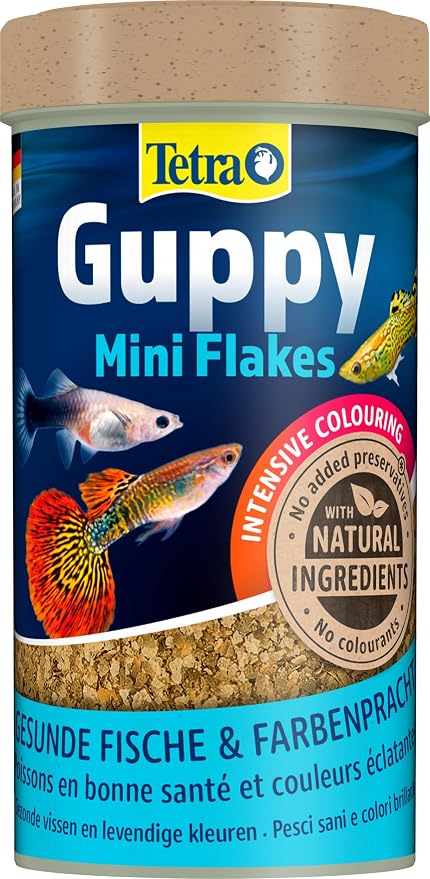
Estos enlaces son de afiliado de Amazon. Si compras a través de ellos, recibo una pequeña comisión sin ningún coste adicional para ti. Me ayuda a mantener esta web gratuita. ¡Gracias!
Planifica tu próximo acuario
¿Te encaja este pez? Planifica un acuario a su medida antes de montarlo.